
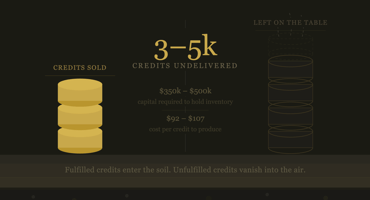
Last year, we left somewhere between 3,000 and 5,000 carbon credits on the table. Not because the...
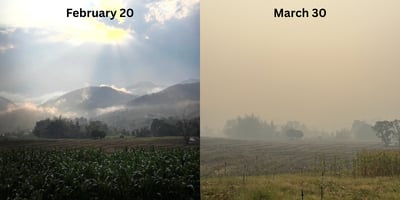
The rains arrived a few weeks ago. I walked outside for the first time without my eyes stinging. The mountains were back. The valley was green again, washed clean overnight, and the air tasted like air. After the worst smoke season I have experienced in over a decade of living in these hills, it felt like breathing for the first time.

And then I read that Microsoft had paused all new carbon removal purchases.
Let me give you a sense of what that means for the market we operate in. Microsoft accounted for somewhere between 80 and 90 percent of all global engineered carbon dioxide removal demand. It was not just the largest buyer in the carbon removal market. In many ways, it was the market itself. In fiscal year 2025 alone, it made deals with 21 companies around the world to remove a record 45 million tonnes of CO2. On April 10, staff at Microsoft told some developers of carbon removal credits that the company is pausing what is currently the world's biggest programme for financing the extraction of CO2 from the atmosphere.
Even before Microsoft's announcement, there were too many suppliers in the space and not enough demand to absorb them. The pause did not create a fragile market. It revealed one.
I want to be honest about something: this did not directly cost Biochar Life a contract. We are a small social enterprise working with smallholder farmers in Northern Thailand and Indonesia, and we were not in Microsoft's procurement pipeline. But the pause matters to us — and to projects like ours — because of what it signals about how the carbon market thinks about value.
Here is the question nobody seems to be asking loudly enough: What exactly paused when Microsoft paused?
The answer the market is focused on is tonnes of CO2. Fair enough. That is what was being purchased. But if you are standing in a village in Northern Thailand — if you watched this season's smoke roll in across the valley and choke out the light for weeks — you understand that a tonne of CO2 avoided or removed is never only that. It is also a field that didn't burn. A child who didn't spend a week indoors with a headache. A farmer who earned income from doing something different with the waste that would otherwise have become the haze we were all breathing.
None of that appears on a carbon credit. None of it is priced into a procurement decision. And none of it pauses when a buyer steps back.
The carbon market has a co-benefits problem. Not in the sense that co-benefits don't exist — they do, they are real, and in the case of agricultural burning in Southeast Asia, they are enormous. The problem is that the market has never seriously tried to price them.
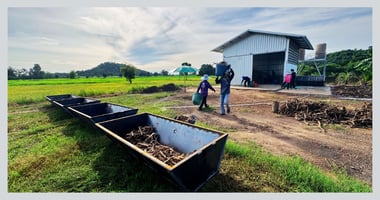
We work with thousands of smallholder farmers across Thailand, Indonesia, Kenya and Malawi. These are people who have been burning their agricultural waste for generations — not because they don't care about the air, but because they had no alternative and no incentive to change. Biochar gives them both. The waste becomes a stable carbon-rich soil amendment instead of smoke. The farmer earns income from the process. The carbon stays in the ground. The sky, in a good year, stays visible.
The co-benefits of that transaction are significant: reduced PM2.5 pollution across some of the most smoke-affected regions in Southeast Asia, improved soil health and reduced dependence on chemical fertilisers, direct income for farming communities with very few other economic options, and the long-term preservation of a farming system that does not depend on burning.
A corporate carbon buyer looking at a spreadsheet sees one number: tonnes removed, price per tonne. The market, as currently structured, gives them no mechanism to see — let alone pay for — anything else. Some buyers do see it. We have customers in Southeast Asia who understand that what they are purchasing goes beyond the carbon — that the smoke not burned, the farmer paid, the soil improved, are part of the same transaction. They are the exception, not the rule.
That needs to change. And the Microsoft pause is as good a moment as any to say so.
I understand why Microsoft paused. The company's data centre capacity is surging, and its carbon footprint has actually grown despite its removal purchases — a 23.4 percent increase in emissions in 2024 alone, with a similar figure expected for 2025. The financial logic of continuing to buy credits while emissions rise faster than purchases can offset them is genuinely difficult to defend. The scrutiny is legitimate.
But the response to that scrutiny — pausing all new purchases, with no timeline and no detailed explanation — treats the carbon removal market as a discretionary line item rather than a system with real people in it. When a buyer of Microsoft's scale steps back, pivots, bankruptcies, and company shutdowns accelerate. The projects most vulnerable to that are not the large engineered CDR facilities with institutional backing. They are the farmer-led, community-rooted projects where the income from carbon credits is the margin between a burning season and a biochar season.
The market needs Microsoft, or buyers like Microsoft, to return. But it also needs them to return differently: with a clearer understanding of what they are actually purchasing, and a genuine willingness to price it fully.
The rains came to Northern Thailand last week, and the smoke cleared overnight. The mountains reappeared. The farmers in the villages around me are preparing their fields for the season ahead.
Some of them will make biochar from their waste this year. Some of them will earn an income from doing so. The carbon will go into the ground and stay there. The air above their fields will be cleaner for it.
That is worth something. It is worth more than the market currently pays for it. And it will remain valuable whether or not a tech company's sustainability team is having a difficult quarter.
The question the Microsoft pause should be prompting is not whether carbon removal is worth buying. It is whether the market we have built to value it is sophisticated enough to capture what is actually being created.
I do not think it is. Not yet.