


Biochar is most commonly celebrated for its role in enhancing soil health, yet its potential...
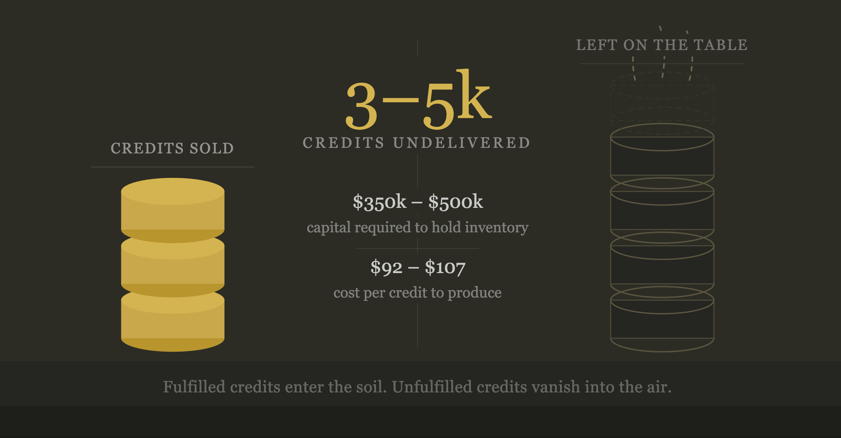
Last year, we left somewhere between 3,000 and 5,000 carbon credits on the table.
Not because the demand wasn't there — it was. Buyers came to us looking for high-quality, verified biochar credits. We couldn't fulfil the requests. To hold that volume of inventory as a small social enterprise, we would have needed between $350,000 and $500,000 in additional working capital. Capital we don't have, tied up in credits with no guarantee of when—or even if —they'd sell.
That gap between demand and our ability to service it forced us to ask some hard questions about how the voluntary carbon market actually works in practice. We don't have clean answers to all of them. But we think they're worth asking out loud.
If businesses are serious about carbon removal, why is there so little planning?
The spot market for high-quality biochar credits is real. We know this because buyers came to us — multiple times — looking for credits available immediately. But spot purchasing, by its nature, places the entire financial burden of inventory risk onto the supplier.
For a large carbon developer with institutional backing, that may be manageable. For a social enterprise working with 1,600 smallholder farmers in Northern Thailand, it isn't.
If a company has a genuine commitment to carbon removal — one embedded in a net zero strategy, signed off by leadership, reported publicly — why is procurement still treated like an afterthought? The credits exist. The verification exists. What seems to be missing is the internal planning that would allow procurement teams to commit twelve months in advance rather than scrambling in Q4.
We're not the only ones asking this. It's becoming a common frustration among smaller, mission-driven suppliers who are doing the hard work of producing high-integrity credits at scale.
Do co-benefits actually mean anything if buyers won't pay for them?
Our credits aren't just carbon. They come with meaningful co-benefits: reduced PM2.5 smoke pollution across Northern Thailand, improved soil health for farming communities, and direct income for smallholder farmers who would otherwise be burning their agricultural waste.
These co-benefits are documented, verified, and real. They're also part of why our production costs sit between $92 and $107 per tonne — a figure that reflects the true cost of doing this work properly, in a remote region, with smallholder farmers, at scale.
In 2025, we received spot requests for credits of $100 or less. At that price point, we are either breaking even or operating at a loss. The buyers requesting those credits were, in many cases, the same buyers who publicly champion high-integrity carbon with strong social impact.
This creates an uncomfortable question: are co-benefits a genuine purchasing criterion, or are they a marketing narrative applied after the fact to the cheapest available credits? We don't think buyers are acting in bad faith. But the gap between stated values and purchasing behaviour is wide enough to warrant an honest conversation.
Is the Q4 spot spike a carbon market problem — or a delivery problem elsewhere?
We noticed a clear pattern in 2025: spot requests accelerated sharply in Q4. This is consistent with what others in the market have observed, and it's worth examining why.
One hypothesis is that some of the late-year demand isn't organic — it's displacement. Companies that made offtake commitments with other technology-based carbon removal providers earlier in the year are discovering, in Q4, that those providers are not going to deliver. Biochar becomes the backstop.
If that's true, it has significant implications. It means spot demand for biochar is partly structural, driven by the unreliability of other CDR pathways. It also means that suppliers like us are being asked to absorb the risk and cost of other parties' delivery failures — at short notice, at compressed prices, with no prior relationship.
We're genuinely uncertain whether this hypothesis is correct. But the pattern is hard to ignore, and it deserves scrutiny from anyone trying to build a resilient carbon procurement strategy.
How should small social enterprises pre-finance spot inventory?
This is the question we don't have an answer to, and we'd genuinely like one.
By definition, spot buyers aren't offering contracts. There is no instrument to take to a bank or an impact investor and say: here is committed future revenue, please advance us the capital to produce against it. The demand is real but undocumented. The risk sits entirely with us.
Larger developers can cross-subsidise from other revenue streams, draw on project finance structures, or absorb short-term losses. We can't — and nor can most of the small, community-rooted projects that tend to produce the most credible and impactful credits.
If the market wants a diverse, resilient supply of high-integrity carbon credits — including from projects like ours — then the financing infrastructure needs to catch up with the demand patterns. That might mean buyers being willing to sign lightweight forward agreements, or it might mean new financial instruments designed specifically for social enterprise carbon developers. We're open to both conversations.
Where does this leave us?
We're not drawing dramatic conclusions. The voluntary carbon market is young, imperfect, and genuinely trying to improve. We believe in it enough to have built our organisation around it.
But 5,000 credits left on the table — and the questions that number raises — feel like something worth sharing publicly. Not to complain, but because the market gets better when practitioners speak honestly about what they're experiencing on the ground.
If any of this resonates with you — whether you're a buyer, a broker, an investor, or another developer navigating the same dynamics — we'd be glad to hear how you're thinking about it.
Biochar Life works with over 1,600 smallholder farmers across Northern Thailand to produce verified biochar carbon credits. Our work is independently rated AA–BBB by Sylvera.
-1.png?height=200&name=Modern%20Geometric%20Orange%20Frame%20Fitness%20Gym%20Instagram%20Post%20(1200%20x%20630%20px)-1.png)