
A New Strategy for Climate, Innovation, and People In “Three Tough Truths About Climate,” Bill...
Tackling Carbon and Smoke Pollution—Why More Buyers Are Turning to Biochar in Thailand
Interest in high-integrity carbon removal is on the rise across Southeast Asia, as companies move beyond basic offsetting toward solutions that deliver measurable, long-term impact. This growing momentum is underscored by a flurry of climate and sustainability events in 2025, from the Asia Climate Summit and ASEAN Sustainable Energy Week, to the launch of Bangkok Climate Action Week (BKKCAW), the city’s first climate-focused festival set to take place this September. Together, these events reflect a clear regional shift in priorities toward climate action that is both credible and community-driven.
Companies are no longer satisfied with ticking the carbon box. They're looking for ways to create meaningful, measurable impact—climate action that also benefits people and communities.
In Thailand, one solution is gaining particular attention: a nature-based approach that reduces carbon, clears the air, and puts income directly into the hands of smallholder farmers.
Biochar, a carbon-rich material made from crop waste, sits at the heart of this shift. And it’s not just about long-term carbon removal. For companies operating in the region, biochar offers a powerful way to address two critical challenges at once—tackling climate change and reducing dangerous levels of PM2.5 smoke pollution.
The Hidden Cost of Open Burning
Across Thailand, the burning of crop residues like maize stalks is still widespread. For smallholder farmers, it’s often the only viable way to clear fields ahead of the next planting season. But this practice has a significant cost.
When crop waste is burned in the open, it releases fine particulate matter known as PM2.5 into the air. These microscopic particles are linked to serious health issues, including respiratory illness, heart disease, and premature death. During the dry season, large parts of northern Thailand are regularly blanketed in haze, turning open burning into a public health crisis.
But the damage doesn’t end there. Open burning also releases vast amounts of CO₂ into the atmosphere, contributing to global climate change. It’s a local problem with global consequences—and one that demands new thinking.
Turning Waste into Value
That’s where biochar comes in.
When crop waste is converted into biochar using clean, controlled methods, it locks carbon into a stable form that can stay in the soil for hundreds of years. Instead of becoming smoke, the carbon is sequestered. Instead of polluting the air, the resulting biochar can improve soil fertility, enhance water retention, and boost agricultural yields.
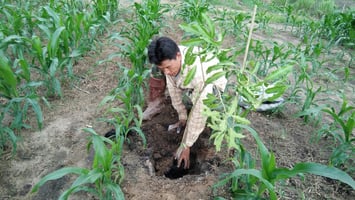
At Biochar Life, we work with smallholder farmers to help them make this transition. We provide training, equipment, and ongoing support so they can produce biochar safely and effectively. The result is what we call the “artisan farmer” model—a decentralized, community-led approach to carbon removal that delivers immediate benefits where they’re needed most.
The biochar our farmers produce is then verified using a digital MRV (Measurement, Reporting, and Verification) system, and issued as long-term carbon removal credits under the Global Artisan C-Sink standard. These credits are backed by real impact: fewer emissions, less smoke, and more income for farming families.
A Shift in Buyer Mindset
What we’re seeing now is a significant shift in how carbon buyers, especially in Southeast Asia, are approaching their sustainability goals.
It’s no longer enough to simply buy carbon credits without having a measured understanding of the social and economic impact. Companies want to know where their money is going. They want to see impact. And increasingly, they want that impact to be felt locally, in the communities they serve.
Biochar offers a clear answer. It’s a science-backed solution that removes carbon from the atmosphere and comes with a host of co-benefits—from cleaner air to healthier soils to job creation in rural areas. It’s verifiable, traceable, and immediate.
As this awareness grows, we’ve seen a wave of new interest from companies in Thailand and across the region. Many are seeking high-integrity, high-impact credits that align with their environmental and social goals.
Early Movers Are Leading the Way
One example is Grab, Southeast Asia’s leading superapp. As part of their sustainability efforts, Biochar Life has been featured directly on the Grab app, allowing users to learn more about our work and the importance of carbon removal with community impact. This kind of visibility helps bridge the gap between consumers, climate action, and the companies making a difference.
Users of the Grab app can now enable a sustainability feature that adds a small contribution—just a few baht—to help offset the emissions from their ride. These micro-contributions go directly into our projects, enabling smallholder farmers to produce more biochar instead of burning crop waste. It’s a simple, transparent way for everyday users to support cleaner air, improved soil, and long-term carbon removal, while helping build more sustainable communities across Thailand.
We’re also grateful for the role that Climate Impact X (CIX) has played in enabling these connections. CIX has helped create a trusted platform where buyers can find projects like ours, helping to accelerate the growth of high-integrity nature-based solutions.
A Model That Works
In Thailand, Biochar Life has already trained hundreds of farmers to adopt clean burning practices, and we’re expanding across new regions. All credits issued through our programs are ICROA-endorsed and follow rigorous verification processes. But beyond the technical side, what motivates us most is the human impact: the farmer who no longer needs to burn her field, the child breathing cleaner air, the village earning new income from waste that was once discarded.
We believe that’s the kind of climate solution the world needs more of—and clearly, so do today’s buyers.
Looking Ahead
As Southeast Asia continues to grow and urbanize, the pressure to address both emissions and air pollution will only intensify. The good news is that solutions exist—and they’re already working on the ground.
Biochar is just one of them. But it’s one with extraordinary potential: to cool the planet, clear the air, and empower the people most affected by both. With more forward-thinking buyers stepping up to support this work, we’re hopeful that a cleaner, healthier future is not just possible—it’s already taking root.
If your organization is interested in supporting carbon removal with real local impact, we’d love to hear from you. The future of climate action in Southeast Asia is collaborative, community-powered, and already underway.
-1.png?height=200&name=Modern%20Geometric%20Orange%20Frame%20Fitness%20Gym%20Instagram%20Post%20(1200%20x%20630%20px)-1.png)